FAIR Food: A DEI Strategy for Sustainable Food Places
The new DEI (Diversity, Equity, Inclusion) strategy for the Sustainable Food Places programme (SFP) begins with this statement:
"As a programme and network, we are committed to being purposefully and proactively awake to discrimination, under-representation and injustice in our work."
I wrote this to challenge the bluster of politicians and commentators who dismiss DEI as irrelevant or "woke." I disagree entirely. Representation and justice are key to lasting, positive change and genuinely participatory development.
If that is "woke," then I'm proud to be woke.
FAIR Food
The strategy framed by this statement is FAIR Food: Framework for Action on Inclusion and Representation in food systems work. It builds on the anti-racism work SFP began in 2020 under the banner of REDI for Change (Race Equity Diversity and Inclusion).
The core premise is simple:
-
Local food partnerships must genuinely reflect their communities.
-
Anyone who wants to engage with food system decision-making should be able to do so.
-
Partnerships and their leaders need to be inclusive, diverse, and justice-oriented.
This scope goes beyond race alone. FAIR Food offers a broader framework for action, ensuring that representation and justice are embedded into local food work across the UK.
Four Key Questions
Early planning raised four central questions:
-
How do we broaden our focus without losing the essential emphasis on race achieved by REDI for Change?
-
How do we recognise the different partnership models, governance structures, and cultural contexts across the UK's 120 food partnerships?
-
How do we decide which groups and communities are most under-represented and excluded in our food systems work?
-
What does good practice actually look and feel like in this context?
At programme level, we didn't have the local experience or perspectives to answer these alone. We needed to listen to those leading food partnerships—especially people with lived experience of discrimination, marginalisation, and under-representation.
That meant co-developing the strategy.
Co-Development in Practice
Co-dev elopment (or co-production) is a collaborative process where people with relevant lived experience work alongside organisations from start to finish. Relationships are equal and sustained.
Food Matters has embedded co-development into all its participatory practice. It was the natural approach for shaping FAIR Food.
In spring 2025, I began leading a co-development process grounded in the four key questions. Working with colleagues from SFP's six programme partners—Food Matters, Soil Association, Sustain, Food Sense Wales, Nourish Scotland, and Nourish Northern Ireland—we organised eight Listening Sessions across the UK.
These were a mix of three-hour online events and full-day in-person workshops.
The Listening Sessions
We were clear about their scope. Participants already recognised the need for representation and justice, and understood the challenges of developing a strategy for 120 partnerships.
The sessions were not training events, forums for long discussions on definitions, or spaces for sharing individual stories of discrimination.
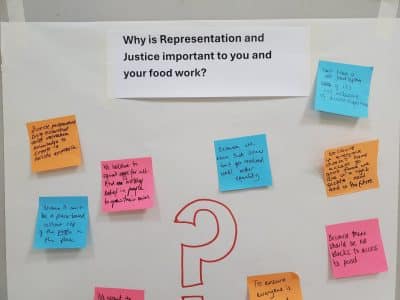
Instead, we focused directly on the nuts and bolts of how to shape a strategic framework for action that avoided being too prescriptive, allowing flexibility for food partnerships to approach challenges and barriers they face in ways that are relevant to their capacity and expertise. To do this, we listened to what participants had to say – carefully facilitating conversations, sometimes in pairs or small groups, sometimes all together – using flipcharts and post-its, allowing participants to document their own comments and suggestions. We kept it simple focusing on the 4 key questions but allowing conversations to expand and evolve in response to what was being said.
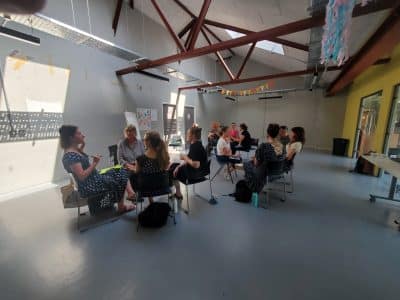
A listening session underway in Cardiff
The sessions were extremely valuable, sometimes intense and energetic and always enlightening.
Who Took Part
Most participants were leaders or active members of food partnerships, many bringing lived experience of exclusion. One session was dedicated to young people aged 14–25, showing how expert panels could represent specific groups or communities.
From these sessions, outputs were distilled into a draft framework for action. A co-development working group was recruited from the listening sessions, and this working group ultimately co-produced FAIR Food.
As one participant reflected:
"…such a well-held set of meetings, it really feels genuinely co-created and participatory. So happy to have been part of it."
A Practical Framework for Action
Because of this co-development process, FAIR Food is:
-
Practical – designed to be usable by partnerships with different resources and capacities.
-
Non-prescriptive – offering flexibility to address barriers in ways that make sense locally.
-
Evolving – as partnerships adopt it, examples of good practice will be added to the framework.
From next year, training sessions will support partnerships to adopt and adapt the framework. In turn, their experiences will continue to shape it—an ongoing cycle of co-development.
Looking Ahead
I think everyone involved in this process should be very proud of this work and the approach that has been used to co-develop it. Hopefully it will support local food partnerships by providing a framework that makes sense to them and helps them in making the change to become more awake to discrimination, under-representation and injustice in their work..
FAIR Food: A DEI Strategy for Sustainable Food Places
The new DEI (Diversity, Equity, Inclusion) strategy for the Sustainable Food Places programme (SFP) begins with this statement:
"As a programme and network, we are committed to being purposefully and proactively awake to discrimination, under-representation and injustice in our work."
I wrote this to challenge the bluster of politicians and commentators who dismiss DEI as irrelevant or "woke." I disagree entirely. Representation and justice are key to lasting, positive change and genuinely participatory development.
If that is "woke," then I'm proud to be woke.
FAIR Food
The strategy framed by this statement is FAIR Food: Framework for Action on Inclusion and Representation in food systems work. It builds on the anti-racism work SFP began in 2020 under the banner of REDI for Change (Race Equity Diversity and Inclusion).
The core premise is simple:
-
Local food partnerships must genuinely reflect their communities.
-
Anyone who wants to engage with food system decision-making should be able to do so.
-
Partnerships and their leaders need to be inclusive, diverse, and justice-oriented.
This scope goes beyond race alone. FAIR Food offers a broader framework for action, ensuring that representation and justice are embedded into local food work across the UK.
Four Key Questions
Early planning raised four central questions:
-
How do we broaden our focus without losing the essential emphasis on race achieved by REDI for Change?
-
How do we recognise the different partnership models, governance structures, and cultural contexts across the UK's 120 food partnerships?
-
How do we decide which groups and communities are most under-represented and excluded in our food systems work?
-
What does good practice actually look and feel like in this context?
At programme level, we didn't have the local experience or perspectives to answer these alone. We needed to listen to those leading food partnerships—especially people with lived experience of discrimination, marginalisation, and under-representation.
That meant co-developing the strategy.
Co-Development in Practice
Co-development (or co-production) is a collaborative process where people with relevant lived experience work alongside organisations from start to finish. Relationships are equal and sustained.
Food Matters has embedded co-development into all its participatory practice. It was the natural approach for shaping Making the Change.
In spring 2025, I began leading a co-development process grounded in the four key questions. Working with colleagues from SFP's six programme partners—Food Matters, Soil Association, Sustain, Food Sense Wales, Nourish Scotland, and Nourish Northern Ireland—we organised eight Listening Sessions across the UK.
These were a mix of three-hour online events and full-day in-person workshops.
The Listening Sessions
We were clear about their scope. Participants already recognised the need for representation and justice, and understood the challenges of developing a strategy for 120 partnerships.
The sessions were not training events, forums for long discussions on definitions, or spaces for sharing individual stories of discrimination.
Instead, we focused directly on the nuts and bolts of how to shape a strategic framework for action that avoided being too prescriptive, allowing flexibility for food partnerships to approach challenges and barriers they face in ways that are relevant to their capacity and expertise. To do this, we we listened to what participants had to say – carefully facilitating conversations, sometimes in pairs or small groups, sometimes all together – using flipcharts and post-its, allowing participants to document their own comments and suggestions. We kept it simple focusing on the 4 key questions but allowing conversations to expand and evolve in response to what was being said.
A listening session underway in Cardiff
The sessions were extremely valuable, sometimes intense and energetic and always enlightening.
Who Took Part
Most participants were leaders or active members of food partnerships, many bringing lived experience of exclusion. One session was dedicated to young people aged 14–25, showing how expert panels could represent specific groups or communities.
From these sessions, outputs were distilled into a draft framework for action. A co-development working group was recruited from the listening sessions, and this working group ultimately co-produced the Making the Change strategy, which saw a soft launch in mid-September.
As one participant reflected:
"…such a well-held set of meetings, it really feels genuinely co-created and participatory. So happy to have been part of it."
A Practical Framework for Action
Because of this co-development process, FAIR Food is:
-
Practical – designed to be usable by partnerships with different resources and capacities.
-
Non-prescriptive – offering flexibility to address barriers in ways that make sense locally.
-
Evolving – as partnerships adopt it, examples of good practice will be added to the framework.
From next year, training sessions will support partnerships to adopt and adapt the framework. In turn, their experiences will continue to shape it—an ongoing cycle of co-development.
Looking Ahead
I think everyone involved in this process should be very proud of this work and the approach that has been used to co-develop it. Hopefully it will support local food partnerships by providing a framework that makes sense to them and helps them in making the change to become more awake to discrimination, under-representation and injustice in their work..