Across the UK, food partnerships are modelling how we can effectively take climate action. Grounded in local places and built on collaboration, they bring together councils, communities, producers, businesses, and civil society to take joined-up action across the food system. Their strength lies in their ability to take bold national & international ambitions, and translate them into practical action that works at smaller scales in local contexts. These actions help model how we can begin – in tangible ways – to take action on climate change within our local food systems.
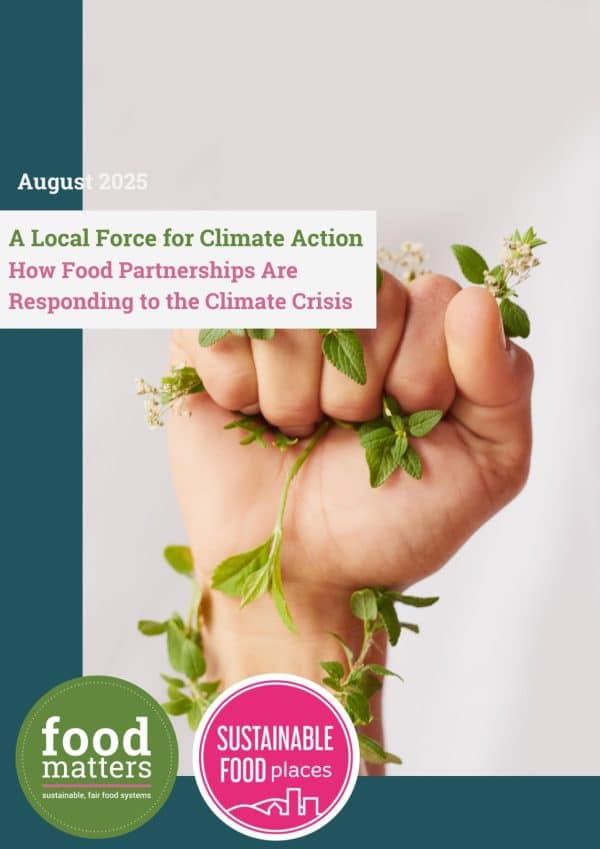
Our latest report – 'A Local Force for Climate Action: How Food Partnerships are Responding to the Climate Crisis' – brings together compelling examples of how food partnerships are turning climate goals into everyday action. With corresponding policy asks, we demonstrate how partnerships are:
- Supporting sustainable and agroecological farming – and why we should invest in food partnerships as trusted brokers of agroecological transition that connect land, training, and community for a more sustainable food system.
- Reducing food waste and closing resource loops – and why we should recognise and fund food partnerships as local catalysts for waste prevention and circular food systems that connect climate action, community benefit, and resource efficiency.
- Promoting healthier, climate-friendly diets – and why we should back food partnerships to lead local transitions toward healthy, sustainable diets, through procurement, education, and public engagement.
- Building resilience to shocks and supply disruptions – and why we should position food partnerships as core local infrastructure for food resilience, linking emergency response with long-term adaptation and equity.
- Strengthening governance and collaboration for long-term change – and why we should mandate the development of local or regional food strategies in every authority across the UK, supported by national frameworks that allow for place-based tailoring.
Read the full report here to learn more about how food partnerships can help us meet our climate targets, and why they should be better recognised and resourced in this work.
Across the UK, food partnerships are modelling how we can effectively take climate action. Grounded in local places and built on collaboration, they bring together councils, communities, producers, businesses, and civil society to take joined-up action across the food system. Their strength lies in their ability to take bold national & international ambitions, and translate them into practical action that works at smaller scales in local contexts. These actions help model how we can begin – in tangible ways – to take action on climate change within our local food systems.
Our latest report – 'A Local Force for Climate Action: How Food Partnerships are Responding to the Climate Crisis' – brings together compelling examples of how food partnerships are turning climate goals into everyday action. With corresponding policy asks, we demonstrate how partnerships are:
- Supporting sustainable and agroecological farming – and why we should invest in food partnerships as trusted brokers of agroecological transition that connect land, training, and community for a more sustainable food system.
- Reducing food waste and closing resource loops – and why we should recognise and fund food partnerships as local catalysts for waste prevention and circular food systems that connect climate action, community benefit, and resource efficiency.
- Promoting healthier, climate-friendly diets – and why we should back food partnerships to lead local transitions toward healthy, sustainable diets, through procurement, education, and public engagement.
- Building resilience to shocks and supply disruptions – and why we should position food partnerships as core local infrastructure for food resilience, linking emergency response with long-term adaptation and equity.
- Strengthening governance and collaboration for long-term change – and why we should mandate the development of local or regional food strategies in every authority across the UK, supported by national frameworks that allow for place-based tailoring.
Read the full report here to learn more about how food partnerships can help us meet our climate targets, and why they should be better recognised and resourced in this work.