Oxford Real Farming Conference 2026
Each January, the Oxford Real Farming Conference (ORFC) brings together farmers, growers, food producers, organisers and advocates working towards progressive, fair and regenerative farming — in the UK and globally. There's an incredible range of events, which are often at full capacity. Slightly frustrating when you're trying to get in, but reflective of how important the issue of sustainable and fair food feels to people. And – rightly so. We're sitting through the wettest Winter in the UK on record, whilst at the same time we're witnessing legitimate farmer grievances around unfair supply chains and economic pressures getting exploited to promote anti-democratic, racist, and climate denial agendas.
One City, Two Conferences
This tension was perfectly exemplified by a rather surreal experience on the Thursday of the conference: stepping outside of the town hall to be confronted by a full-on car-chase, in which a police squad car were chasing a huge tractor hurtling at full-speed down the High Street.
ORFC runs as a counter-protest to the more mainstream Oxford Farming Conference, which historically has been a space for agribusiness leaders, policymakers, and politicians to gather. The ORFC was borne from a desire to highlight the alternatives to conventional agriculture and to offer a different kind of farming conference. There was something both absurd and symbolic about a tractor – a protestor from the Oxford Farming Conference – getting chased by police cars through the quaint streets of Oxford. It was expressive of the dissatisfaction felt by farmers at the current agricultural system; but also the myriad of ways in which this dissatisfaction can be capitalised upon. This is something that the far-right are well aware of, and mobilising around.
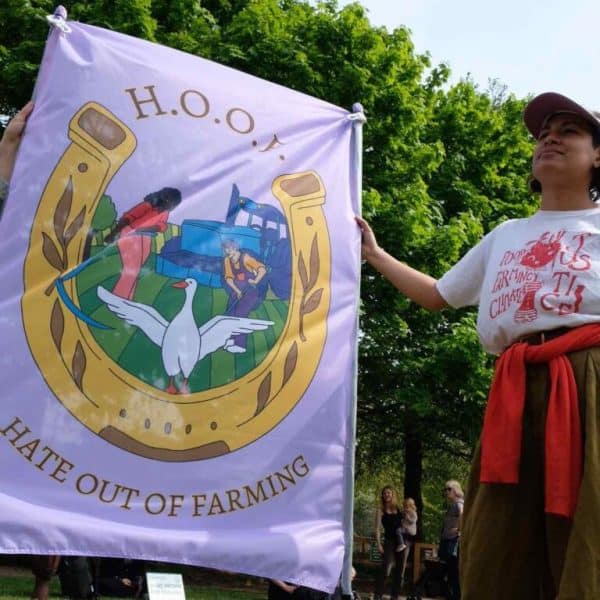
Photo copyright – Landworkers Alliance
Combatting Hate in Food and Farming
How can we, in the sustainable farming movement, face the rise of far-right influence in agriculture? A collective response is urgently needed – but what could this look like?
These were some of the questions framing the 'Combatting Hate in Food and Farming: Practical Actions for Solidarity' panel discussion that we were humbled to be part of, joined by cee-cee manrique and Ed Gardener, both growers and members of the The Landworkers' Alliance Hate Out of Farming group.
Across Europe and beyond, we are seeing highly organised political movements positioning themselves as the sole defenders of farmers, strategically and deliberately mobilising the grievances of farmers – many of whom exist in pockets of isolation, or underfunding. Some key takeaways from this panel were that:
- It's important for the food movement to address the sense of marginalisation, disrespect, and disaffection felt by many mainstream farmers – finding ways to better represent and include farmers voices in sustainable food systems transformation.
- Rather than just postulating the sustainable food movement as the 'good guys', we need to find meaningful and convincing counter-narratives, built around co-operative economies and food sovereignty that promote inclusion, rather than exclusion.
- The rise of the far-right is a highly organised and well-resourced global phenomenon exploiting and creating division. This must be challenged and countered by a similarly well-organised and resourced counter-movement, that has invested in political education.
FAIR Food:
A huge part of our partnership with Sustainable Food Places over the last few years has been around embedding representation and justice in their ethos, and making this a core part of food partnerships across the country. Their newly released Framework for Action on Inclusion and Representation (FAIR) in food systems framework aims to explore and share experience around engaging farmers in food systems, meaningfully. This means at decision-making and policy level – not just as an afterthought. We hope this is one step towards increasing representation and decreasing dissatisfaction, through meaningful engagement.
Be more dung beetle
In the opening speech we heard from Claire Whittle, describing how we need to be more dung beetle – taking an active role in breaking down the crap that surrounds us and turn it into something more nourishing. The 'crap' currently surrounding us is immense – – but places like the ORFC allow us to come together and channel both our anger and our worries into moments for connection, organising, and reflection. Once again, it proved a vital space for exchange and connection for the alternative food movement – and one taking place in an extremely tense time in the food and farming world.
Our hope is to take the legitimate grievances aimed against our food systems and food chains, and bring them into a stronger, united, sustainable food movement. For, as is becoming increasingly clear, the sustainable food movement is not the only alternative food movement making noise.
Watch the full video from our panel discussion below:

Oxford Real Farming Conference 2026
Each January, the Oxford Real Farming Conference (ORFC) brings together farmers, growers, food producers, organisers and advocates working towards progressive, fair and regenerative farming — in the UK and globally. There's an incredible range of events, which are often at full capacity. Slightly frustrating when you're trying to get in, but reflective of how important the issue of sustainable and fair food feels to people. And – rightly so. We're sitting through the wettest Winter in the UK on record, whilst at the same time we're witnessing legitimate farmer grievances around unfair supply chains and economic pressures getting exploited to promote anti-democratic, racist, and climate denial agendas.
One City, Two Conferences
This tension was perfectly exemplified by a rather surreal experience on the Thursday of the conference: stepping outside of the town hall to be confronted by a full-on car-chase, in which a police squad car were chasing a huge tractor hurtling at full-speed down the High Street.
ORFC runs as a counter-protest to the more mainstream Oxford Farming Conference, which historically has been a space for agribusiness leaders, policymakers, and politicians to gather. The ORFC was borne from a desire to highlight the alternatives to conventional agriculture and to offer a different kind of farming conference. There was something both absurd and symbolic about a tractor – a protestor from the Oxford Farming Conference – getting chased by police cars through the quaint streets of Oxford. It was expressive of the dissatisfaction felt by farmers at the current agricultural system; but also the myriad of ways in which this dissatisfaction can be capitalised upon. This is something that the far-right are well aware of, and mobilising around.
Photo copyright – Landworkers Alliance
Combatting Hate in Food and Farming
How can we, in the sustainable farming movement, face the rise of far-right influence in agriculture? A collective response is urgently needed – but what could this look like?
These were some of the questions framing the 'Combatting Hate in Food and Farming: Practical Actions for Solidarity' panel discussion that we were humbled to be part of, joined by cee-cee manrique and Ed Gardener, both growers and members of the The Landworkers' Alliance Hate Out of Farming group.
Across Europe and beyond, we are seeing highly organised political movements positioning themselves as the sole defenders of farmers, strategically and deliberately mobilising the grievances of farmers – many of whom exist in pockets of isolation, or underfunding. Some key takeaways from this panel were that:
- It's important for the food movement to address the sense of marginalisation, disrespect, and disaffection felt by many mainstream farmers – finding ways to better represent and include farmers voices in sustainable food systems transformation.
- Rather than just postulating the sustainable food movement as the 'good guys', we need to find meaningful and convincing counter-narratives, built around co-operative economies and food sovereignty that promote inclusion, rather than exclusion.
- The rise of the far-right is a highly organised and well-resourced global phenomenon exploiting and creating division. This must be challenged and countered by a similarly well-organised and resourced counter-movement, that has invested in political education.
FAIR Food:
A huge part of our partnership with Sustainable Food Places over the last few years has been around embedding representation and justice in their ethos, and making this a core part of food partnerships across the country. Their newly released Framework for Action on Inclusion and Representation (FAIR) in food systems framework aims to explore and share experience around engaging farmers in food systems, meaningfully. This means at decision-making and policy level – not just as an afterthought. We hope this is one step towards increasing representation and decreasing dissatisfaction, through meaningful engagement.
Be more dung beetle
In the opening speech we heard from Claire Whittle, describing how we need to be more dung beetle – taking an active role in breaking down the crap that surrounds us and turn it into something more nourishing. The 'crap' currently surrounding us is immense – – but places like the ORFC allow us to come together and channel both our anger and our worries into moments for connection, organising, and reflection. Once again, it proved a vital space for exchange and connection for the alternative food movement – and one taking place in an extremely tense time in the food and farming world.
Our hope is to take the legitimate grievances aimed against our food systems and food chains, and bring them into a stronger, united, sustainable food movement. For, as is becoming increasingly clear, the sustainable food movement is not the only alternative food movement making noise.
Watch the full video from our panel discussion below: